
Top marks and lowest price
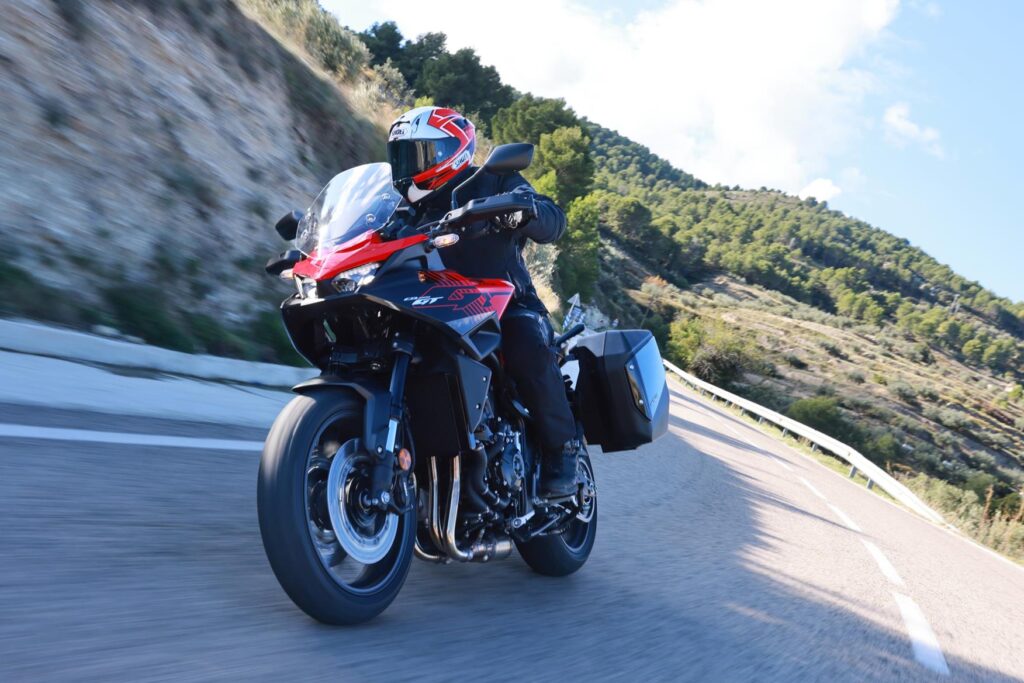
The big news where suspension is concerned is that the GT gains Showa’s Electrically Equipped Ride Adjustment system, or EERA for short. It’s not the first for a Honda, having already appeared on the Africa Twin and NT1100, but it is the first application to get a dedicated Sport setting, in addition to Standard, Tour and Rain.
Working together with the ECU and IMU, the system continuously monitors road speed, bike attitude and stroke rate from forks and shock, allowing it to make real-time adjustments to compression and rebound damping. It takes just 0.015 seconds for the system to react, which makes its operation imperceptible in practical terms, but what really matters is how it enhances the riding experience.
Essentially, the harder the suspension units work, the firmer they get. Under braking it resists excessive dive to keep the forks operating within their normal stroke, and when you accelerate it compensates at the rear to stop the back end squatting unduly. This has the overall effect of trimming out the chassis to keep it settled regardless of control inputs, so that when you’re barrelling through bends, throwing in quick changes of direction, and getting on and off the power, it feels nothing but plush and natural.
EERA settings are selected simultaneously with the appropriate riding mode, and similarly there is a customisable User option. Rear preload can also be adjusted electronically and on-the-go, with four presets to compensate for luggage, pillion or both, plus a more incremental 24-step scale should you wish to add a little extra ride height or make allowances for a particularly heavy lunch.
But there’s much more to the GT’s handling prowess than the trick suspension. The swingarm is 16mm longer than the Hornet, which along with a slight gain in ground clearance and increase in trail has extended the wheelbase by 10mm overall to improve stability. It’s taken nothing away from the nimbleness of the chassis but does help in its overall composure.

Although the main frame hasn’t been altered, the rear subframe has been modified to allow for a pillion and luggage. The necessary reinforcements for an increased load has included additional cross members, which in turn have added stiffness. The GT also has significantly wider handlebars than its stable mate, reducing the effort for steering inputs and making swift changes of direction an absolute joy.
One point worthy of note is that during a high speed run on a closed road, a mild, yet consistent, shimmy developed from the front end. It didn’t become noticeable until around 120mph, and although not severe, did give cause for concern. It’s well outside the Honda’s operating window on public roads, and could be down to a combination of the relatively steep rake and drag from the panniers – Honda have yet to respond in an official capacity to this.

Brakes are Nissin four piston radial calipers up front (not Brembo Stylemas a la Hornet SP), but stopping power wasn’t called into question once on our launch ride among the twisty roads in the rugged hills above Benidorm in southern Spain. Initial bite is well calibrated and there’s plenty of feedback as you squeeze the lever, with the rear brake giving a similar sensation. The twin channel system gets full cornering sensitivity through the internal IMU too.

The riding position has been optimised for long days in the saddle, with the aim of reducing rider fatigue and enhancing the GT’s ability for making relatively effortless progress. This has been achieved by moving the footpegs forward and resculpting the seat, which due to thicker foam has raised the seat height by 16mm. That said, it’s not too much of a stretch with my 32” leg to get both feet flat on the floor, but shorter riders may find it a bit of a struggle, especially on uneven ground.
Pillions get an even better deal with a much broader seat than the Hornet’s postage stamp-sized pad and a whopping 40mm in foam. Rear pegs have also been moved forward to comfortably clear the panniers.

Wind protection is another important factor in preventing rider fatigue, and the whole fairing, including the adjustable screen, has been optimised for efficient aerodynamics. Inboard of those twin ‘horns’ at the front are channels which allow a certain volume of air to flow through the fairing and around the fuel tank, rather than pushing it all over and around the screen.
Honda’s engineers have painstakingly developed ridges within those ducts to disrupt that flow so that the effect on the rider is minimised. It certainly does seem effective in action, more to the point that you don’t notice.

The screen itself works well. In the lowest position it deflects air onto the chest, keeping your helmet in clear air and allowing its own integral aerodynamics to work, but on the highway I found that the highest setting was just enough to direct wind blast clear of my lid’s top vents. It’s not the kind of bubble you’d expect from a big screen on a full fat tourer, but it does enough of a job to prevent uncomfortable buffeting.
Deja una respuesta