
2026-on QJMotor SRK 921 RR review
QJMotor SRK 921 RR expert review
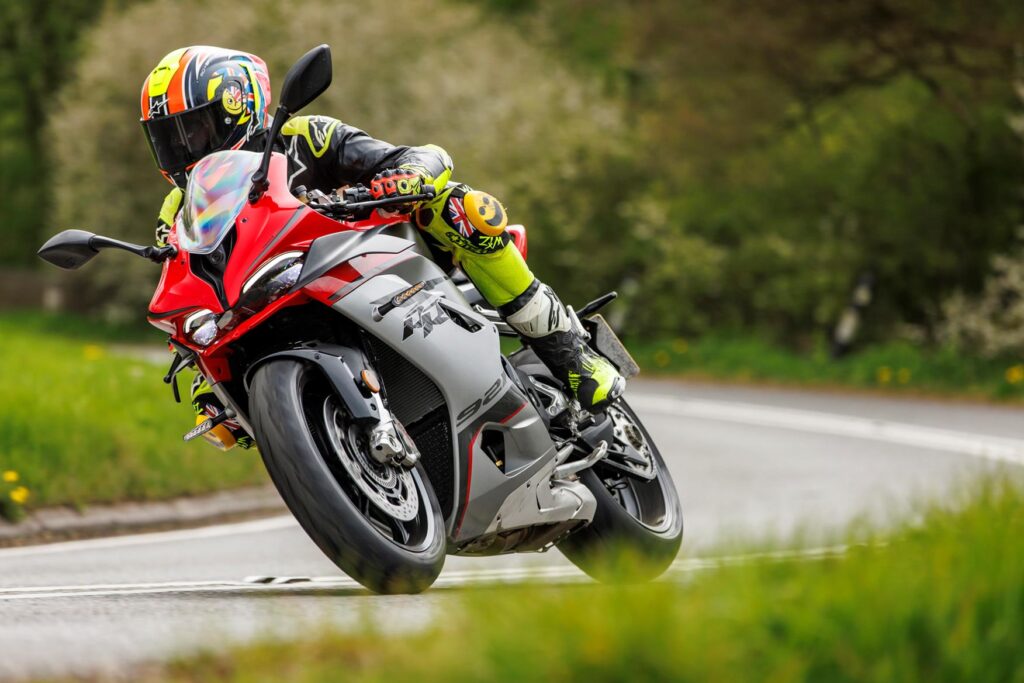
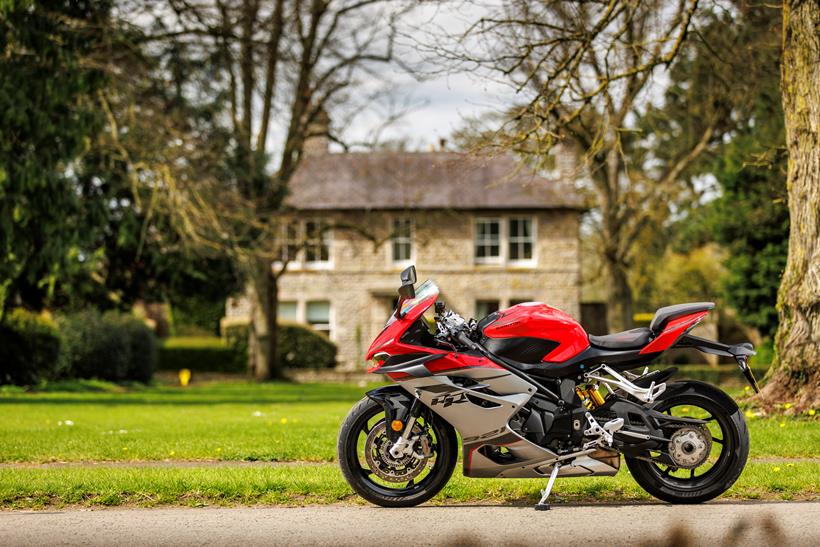
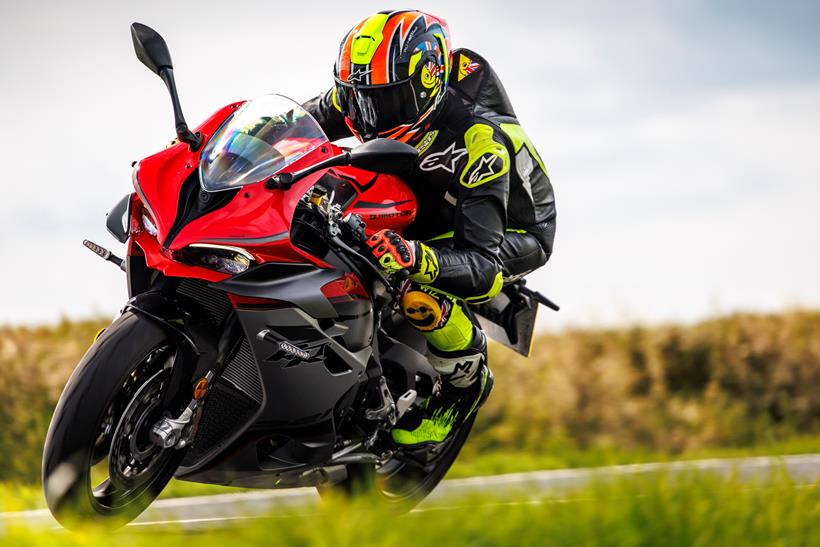
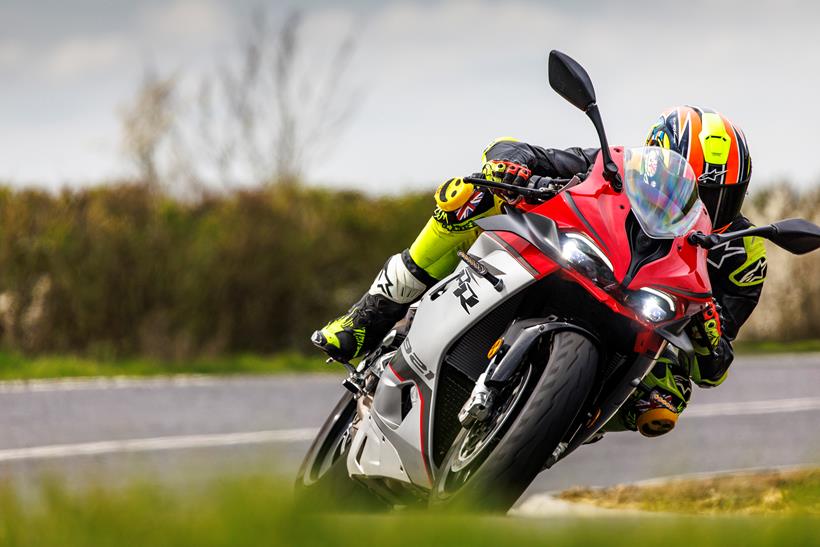
As you can tell from the pictures, QJMotor’s new SRK 921 RR has more than a passing resemblance to an MV Agusta. It looks like one, has a model name like one, sports an Italian flag on the tank and even has a similar key… and it’s not a coincidence.
It was designed by Adrian Morton from C-Creative, who’s penned many a beautiful MV and Benelli over the years, and engineer Paolo Bianchi from CRC-MV’s R&D department. Made under licence from MV, the SRK’s Chinese-made 125bhp, 921cc inline four-cylinder engine once lived in the entry-level 2011 Brutale 920.
It’s housed in a tubular steel chassis with a single-sided swingarm – a staple of MVs since the first F4 750. But one thing that is far from MV territory is the price: just £8999 plus £300 on-the-road charges.
Like this story? You can get more MCN in your life by clicking here and asking Google to make us a preferred source.
Is the QJMotor SRK 921 RR right for you?
Reasons to buy:
+ A great on-the-road sportsbike
+ Well equiped with rider aids and tech
+ High-end components for a competitive price
Reasons to avoid:
– Heavier than some rivals, it could do with losing a few kilos
– Fuelling can be snatchy; it needs smoothing out
– Slower steering reminiscent of 90s bikes of the time
Up close and personal, the SRK 921 RR looks like a three-cylinder MV Agusta F3 trapped in a hall of mirrors, albeit with added wings and a scowling Panigale-esque face.
Unsurprisingly, it barks into life with a similarly crunchy, hollow-sounding F4-like exhaust note, but rather than rasping like an F3 triple, it quickly settles into a smooth but slightly angry inline four-cylinder idle.
Fruity performer
It might have MV blood coursing through its veins and resemble a supersport racer, but to ride the QJMotor is more reminiscent of a big-cube sports bike from the 1990s, like a Yamaha FZR1000 EXUP, or the original 92 Honda Fireblade.
Performance-wise, the SRK 921 RR is quite Blade-like, from its burly midrange to its scenery-blurring top end. There aren’t many modern sportsbikes around with this kind of engine size, configuration or power, apart from perhaps a GSX-R750… which we’ll come to later.
Making 120.5bhp at the rear wheel, it makes the kind of power that’s just about right for a road-going sports bike, and it’s refreshing. You don’t need to thrash it like a smaller-engined, bloodcurdling supersports weapon, and the engine is far sportier and zestier than a parallel twin.
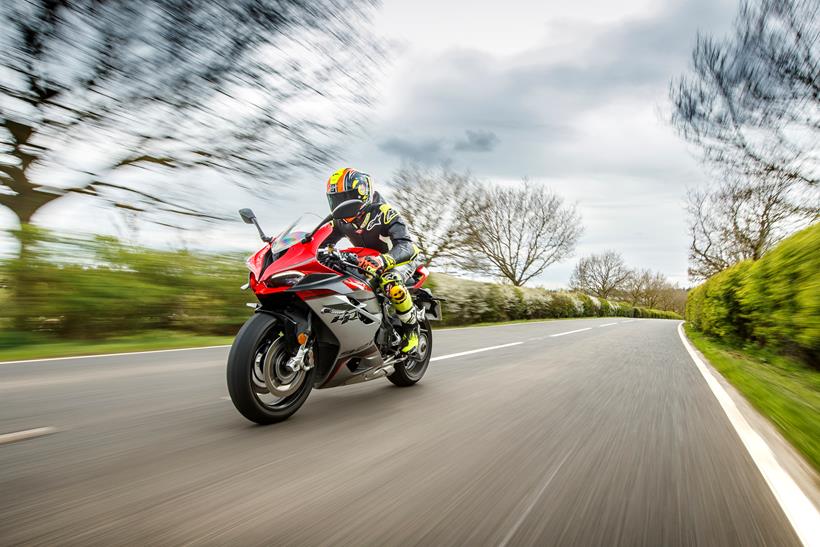
You can enjoy far more of the motor’s good stuff on the road than a modern-day 200bhp superbike, too. Granted, its inline four is a manageable, business-like motor that won’t seduce you, but it does a measured 157mph and with such a fat wodge of power in the midrange, you can cover ground quickly with little effort and without a flurry of gear changes. However, when you want to go, it hits so hard, deep into its redline, you’ll reconsider your Chinese bike perceptions.
This engine wouldn’t have had ride-by-wire when it lived in the Brutale 920 or needed to bow to Euro 5+ regulations, but it does now. With that in mind, the QJMotor is pretty well sorted with its friendly power and a chunky midrange, but it isn’t completely polished.
Picking up a closed throttle isn’t jerky, which is better than MV themselves could do with their first ride-by-wire F3 675, but the engine hunts on a constant throttle, which can be irritating on a straight run. The power curve on BSD Performance’s dyno is spiky, too, but it’s nothing a decent remap couldn’t sort.
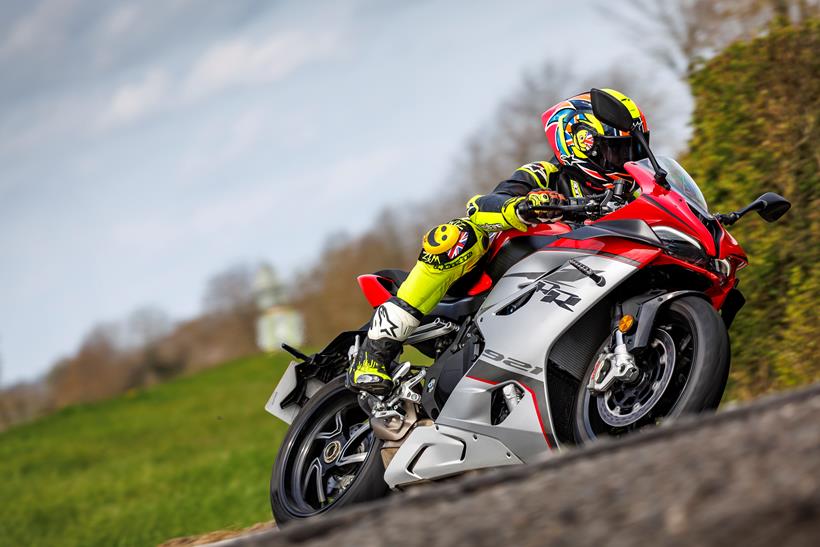
The SRK 921 RR is friendly enough at low speeds, though, and never does anything you don’t want it to do, although the clutch action is heavy. Like any race rep, it’s happier on the open road with the wind in its hair than pootling around town. We saw around 41mpg during our test, which gives a theoretical 144-mile range from its 16-litre fuel tank.
Its ‘Normal’ and ‘Rain’ riding modes are quite lazy, but ‘Sport’ is the most linear, urgent and natural. Gear shifts are light and accurate for the most part (although sometimes clunky at low speed), and the standard-issue up/down quickshifter works flawlessly. Its lean-sensitive traction control and ABS never needed to wake from their slumber during our test.
Solid handler
As well as pounding dual carriageways, motorways and through towns during our time with the SRK 921 RR we also blasted it around our old MCN250 B-road route. It’s the perfect test of handling and ride quality, thanks to its array of technical curves, towering undulations and road surfaces that vary from racetrack-smooth to those found on the far side of the moon.
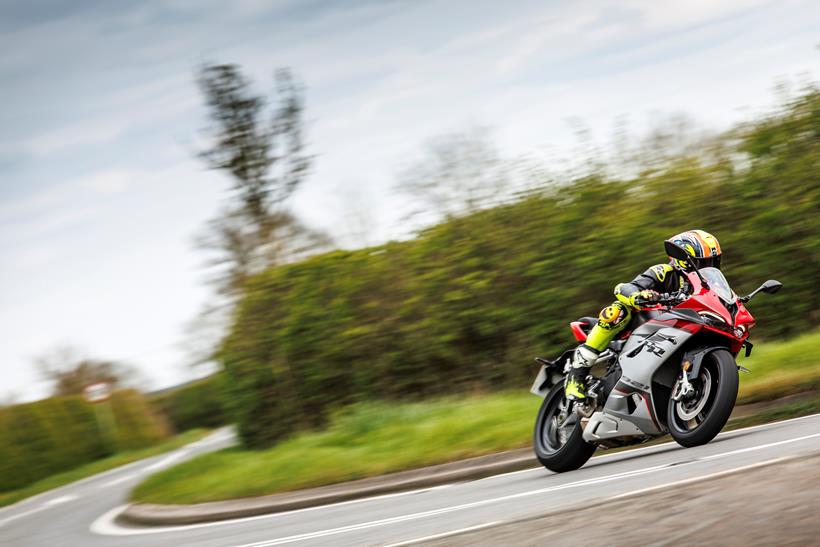
It acquits itself well with unflappable stability, which is exactly why the QJMotor can glide from A to B so swiftly. The bars don’t budge a millimetre accelerating hard over bumps, and it’s solid at road lean angles.
There’s plenty of grip and reassurance from the sporty Pirellis and the ride is on the firm side, just like many MVs, thanks to their stiff chassis, strong suspension springs and huge 50mm diameter forks.
It’s an acceptable price to pay on a race rep when you’re pushing on. The combination of stable handling, electronic safety nets and potent, easy-to-manage power is a delicious recipe for hanging with your mates, no matter how much more their bikes cost.
It’s no lightweight
It’s a heavy beast, and much of that must be down to its huge, cat-filled Euro 5+ collector box, but MV Agustas, with their hefty steel frames, were never the lightest. Squeezing the pips out of our scales at 230.6kg fully fuelled (QJMotor claims 223kg), its bulk takes the shine off the acceleration and agility you’d expect from a machine with such sporty pretensions.
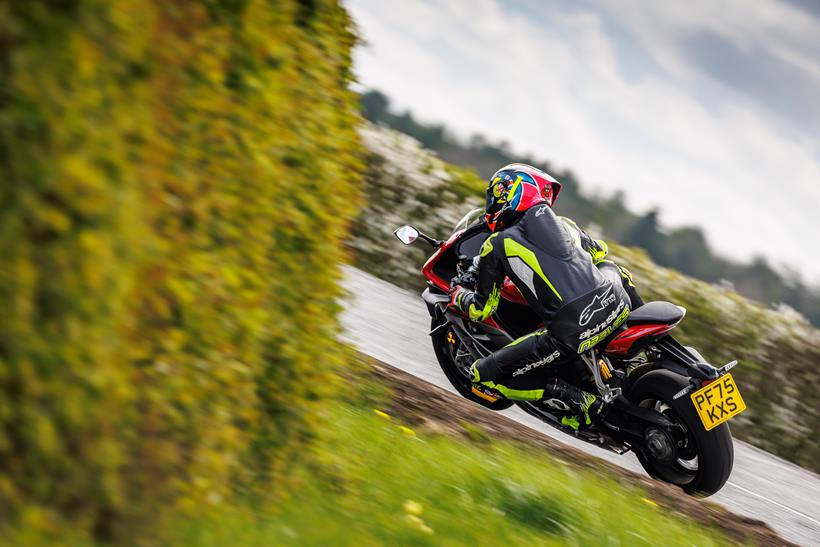
With a measured 53/47 front-to-rear weight bias, it isn’t a natural-born wheelie machine either. Being so heavy, the handling is almost akin to the slightly dead feeling you get from an electric sports bike.
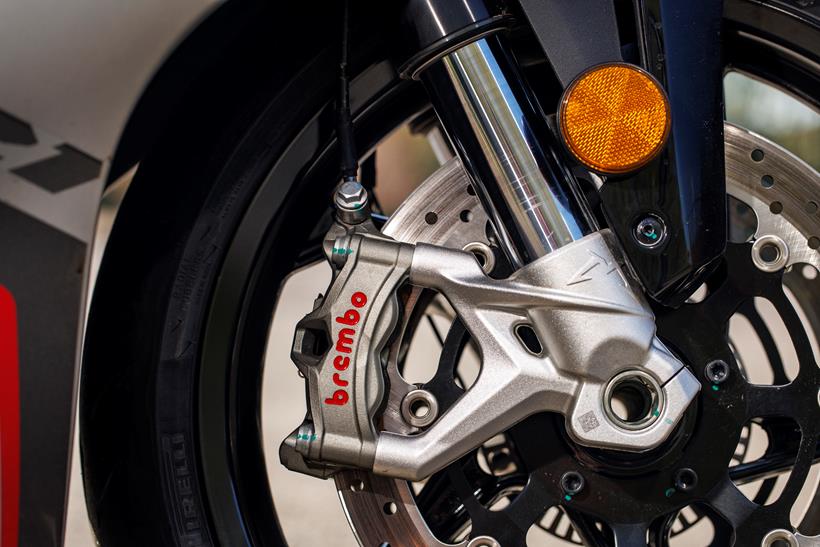
You notice the kilos mostly on the brakes, where the Brembos don’t stop the world coming at you quite as fast as you’d like, but they still do a sterling job of scrubbing off speed with a big squeeze and no unwanted ABS intrusion. The rear disc is a big-for-a-sports-bike 260mm with a twin-piston Brembo calliper, but it lacks any kind of power.
It’s also slow steering, which further gives the QJMotor that 90s sportsbike feel. It doesn’t change direction with a blink of an eye or dive into corners with the lightest touch of the bars. The upside is its unwavering stability, which is perhaps what you need more of for confidence on a fast, bumpy real-world backroad.
Racy riding position
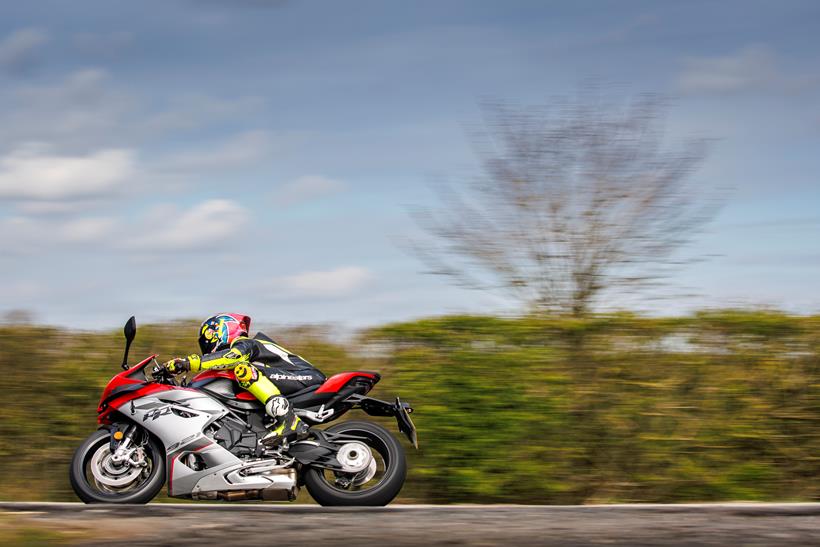
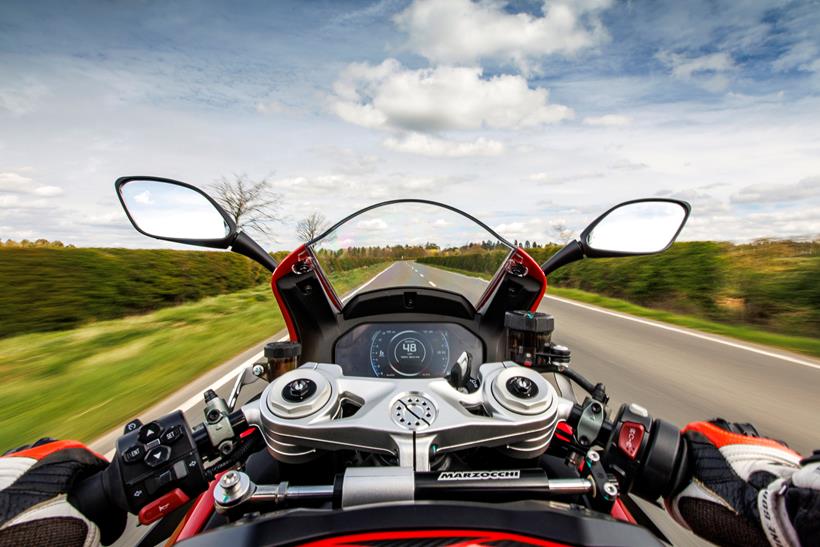
Unsurprisingly, the ergonomics are pure, single-minded, supersport-inspired MV Agusta. While the new generation of softer-edged middleweight sports bikes have wide clip-ons placed above their top yokes, the SRK 921 RR’s are located unapologetically low and narrow, but they’re easy to reach, and you can prop yourself up on the tank with your left arm – old school, to give your left wrist respite.
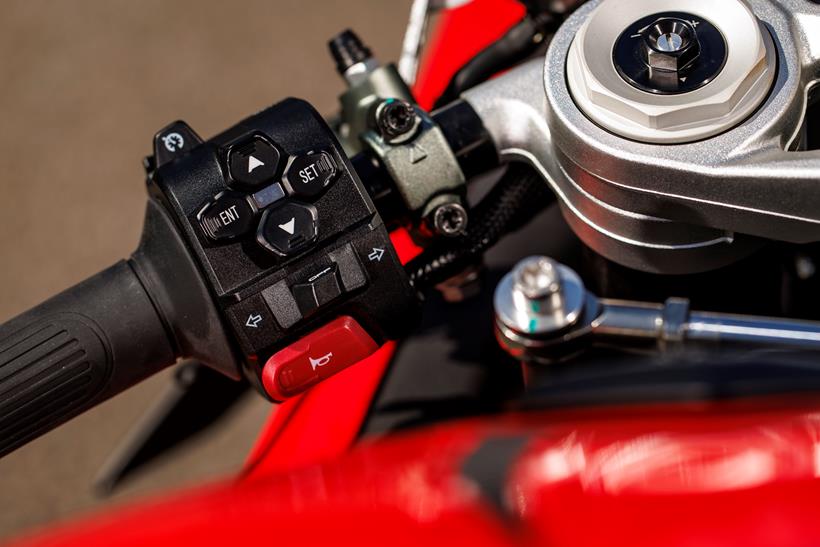
It also comes with adjustable cruise control that allows you to shake life back into your throttle hand on a long trip, too, as well as helping you to keep to speed limits. During our test, the ‘resume’ function didn’t work, though.
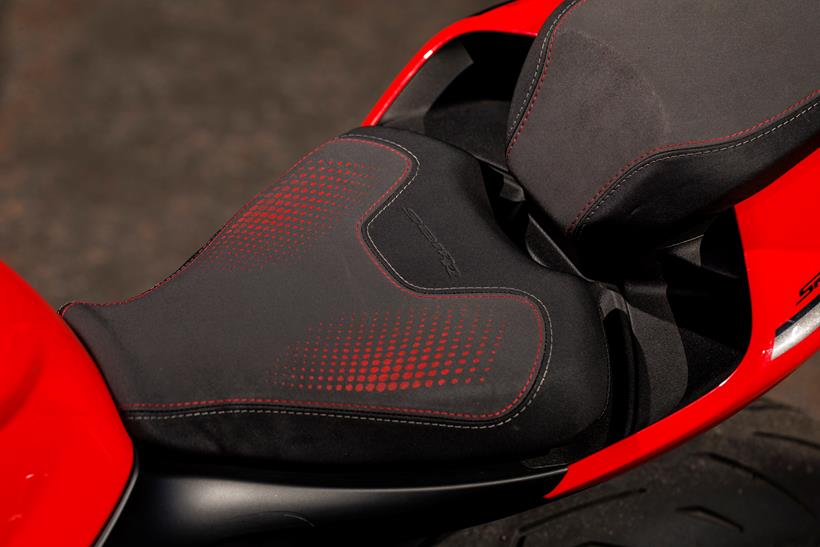
There’s a decent amount of peg-to-seat room for a six-footer, and the seat has plenty of padding, but it squashes down and gets uncomfortable after a while. Mirrors are clear and vibe-free. Sub-1000cc four-cylinder race reps are few and far between, but the now-discontinued (in Europe) Suzuki GSX-R750 is perhaps the closest in spirit to the SRK 921 RR.
I rode my own Suzuki GSX-R750 during this test for comparison, and what the Suzuki lacks in cubic capacity it makes up for with more power (127bhp at the rear wheel on the same BSD dyno). I wish it had the QJMotor’s more generous legroom and cruise control, but the 750 is crisper, more raucous and exciting… and a massive 41kg lighter.
Great value
Affordability is the QJMotor’s real trump card, of course. Not only is it cheaper than similar-sized engined race reps from all the big players, like the Ducati Panigale V2, KTM 990 RC R and Yamaha R9, it costs less than the less powerful Yamaha R7, Aprilia RS660 and is the same price as Suzuki’s GSX-S 8R and Triumph Daytona 660.
For those younger riders who aren’t misty-eyed about the established brands, or simply those on a budget who want a new, exciting, well-equipped sports bike, the QJMotor SRK 921 RR will be tempting.
Build quality is like an entry-level MV. It may not be lavished with exotic billet aluminium parts and carbon fibre (although there are carbon-effect stickers on the tank), but the build quality and fit and finish of everything from the infill panels around the dash to the bodywork and paint are decent.
In fact, there’s very little about the SRK that would mark it out as what we’ve considered to be ‘Chinese’ before, apart from the basic switchgear, Nintendo-esque dash graphics and poorly translated warning stickers on the tank: ‘Must put on safety cap and showy protected clothes’. De-stickered, it would pass as an MV. It comes with a two-year warranty, but the big caveat, of course, is that QJMotor haven’t been in the UK for long enough to gain a reputation for reliability, so the jury is out.
It was all going so well…
During performance testing, the RR developed an engine fault that prevented us from completing our test. QJMotor’s UK importer later told MCN the bike had entered a protective limp mode and that they were investigating what – if any – engine damage had occurred. The importer also stated that the machine had not yet completed its first service and suggested prolonged high-speed testing before the initial oil change might have contributed to the issue. MCN was not advised that the bike was incapable of being ridden to MCN’s evaluation standards prior to testing.
Tech detail
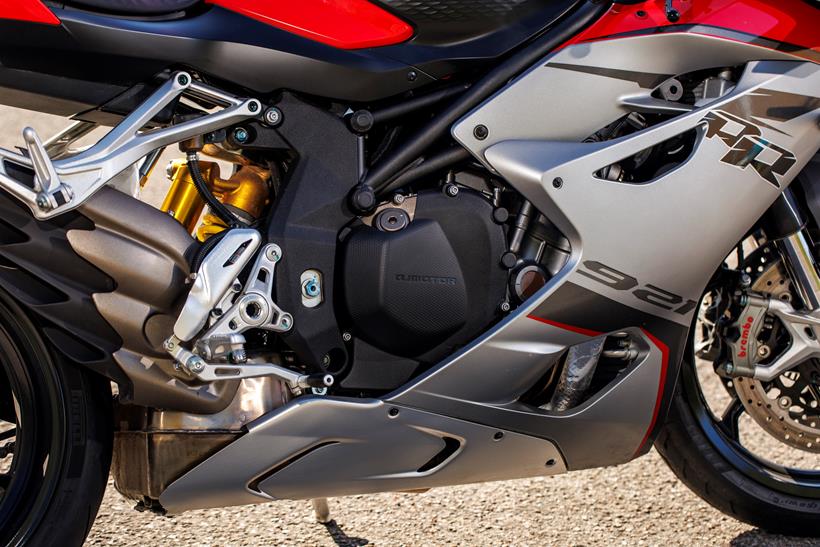
The engine was created in collaboration with MV Agusta, the QJMotor’s 921cc inline-four is essentially the sleeved-down F4 1000 lump that powered the 2011 Brutale 920. It has the same Magneti Marelli fuel injection but modernised with a ride-by-wire throttle and Euro 5+ exhaust.
Making a healthy 120.5bhp @ 11,300rpm on BSD Performance’s dyno, the QJMotor isn’t far off its claimed 125bhp crank figure. Torque is 63.6lb-ft @ 8900rpm. It’s strong in the midrange too, which you feel on the road. Like most modern-generation Chinese machines, it could do with a remap to tidy the fuelling to make it shine.
On our performance test, we clocked the following:
- Top speed: 157.3mph
- 0-60: 3.31 secs
- 0-100: 6.69 secs
- Standing quarter: 11.21secs@128.02mph
- Measured kerb weight: 230.6kg
The chassis housing the MV engine is a typically MV-like tubular steel trellis frame with a cast aluminium back section and single-sided swingarm. Its relatively long 1425mm wheelbase is usually the preserve of a naked that needs more stability than a sports bike. It’s 20mm longer than a ’92 Blade’s, 35mm more than a GSX-R750’s and 45mm more than MV Agusta’s supersport F3.
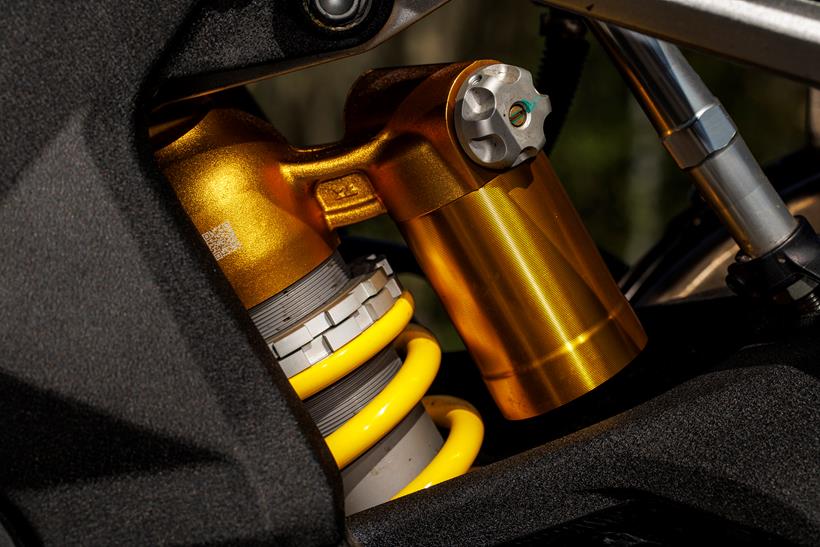
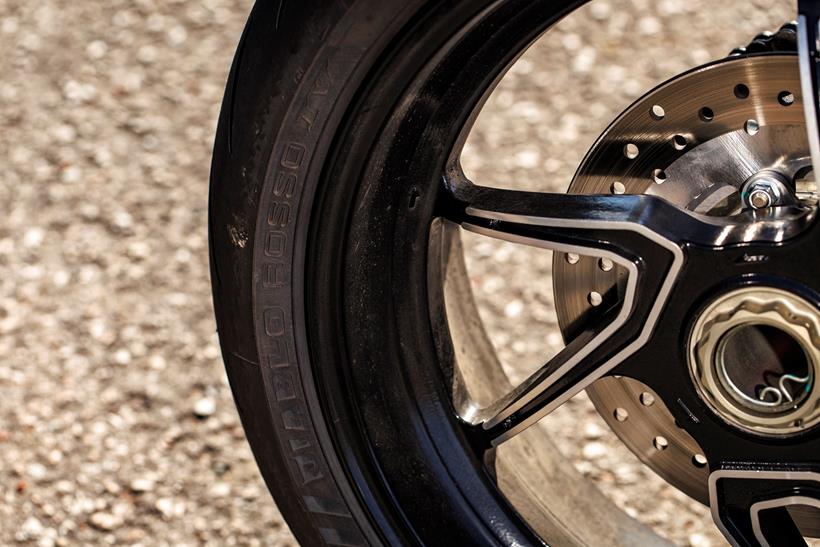
With a chassis just like a late noughties MV Agusta, the SRK 921 RR has a fully adjustable Marzocchi shock, 50mm diameter forks, a steering damper and a rear ride height adjuster. Brembo Stylemas and master cylinder take care of front braking duties, while diamond-cut cast aluminium wheels are shod with Pirelli’s current-generation Diablo Rosso IV sports tyres, using a 190/55 size rear.
Electronics
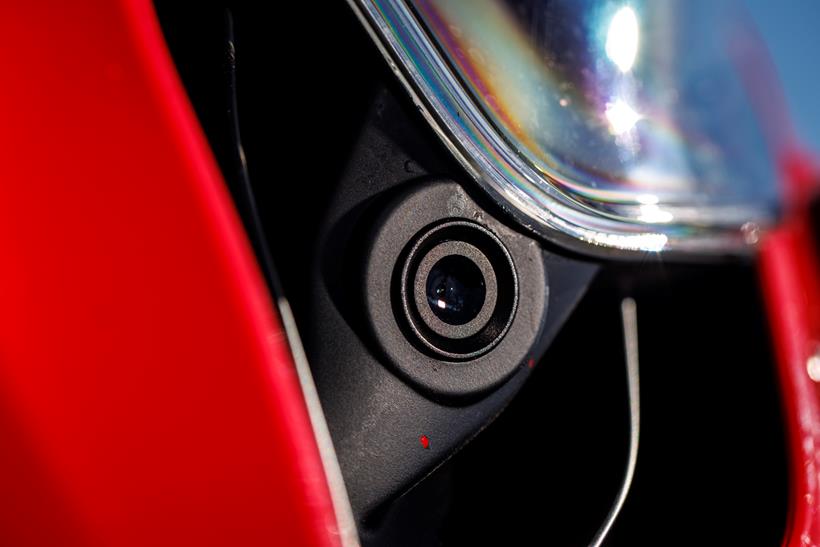
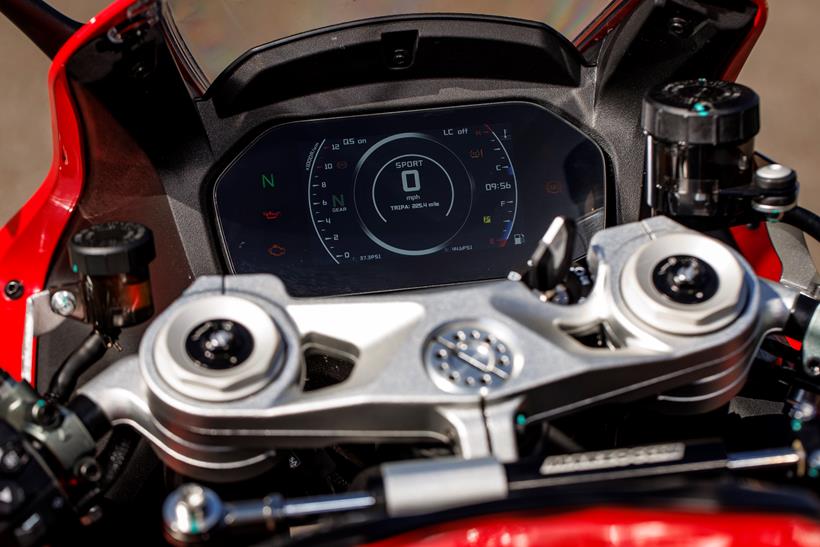
Standard-issue silicone goodies include a multi-function 5in colour dash with connectivity, three riding modes (Rain, Normal and Sport), launch control, tyre pressure monitors, a front-facing camera and USB/USB-C chargers. Thanks to its ride-by-wire system and IMU, it has cruise control, an up/down quickshifter and cornering traction control and ABS.
Display dash
The SRK 921 RR has a five-inch colour dash, has Bluetooth connectivity and lots of info, including a gear position indicator and tyre pressure monitors. Graphics are more computer game than elegant, and small digits can be tricky to read.
Front forks
The 50mm diameter Marzocchi forks were the preserve of MV Agustas, Benellis and Bimotas through the noughties. They offer huge stability on the brakes and through corners, but they lack the feel of more conventional 43mm-size sports bike forks.
Styling
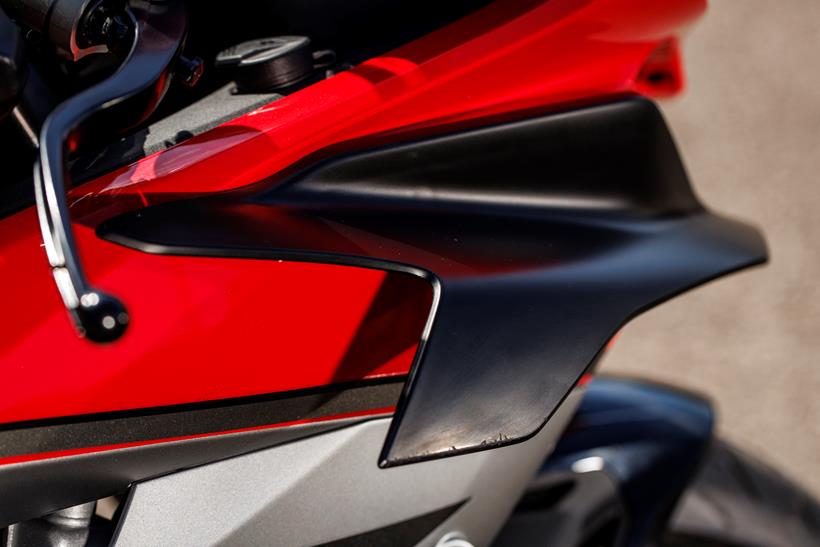
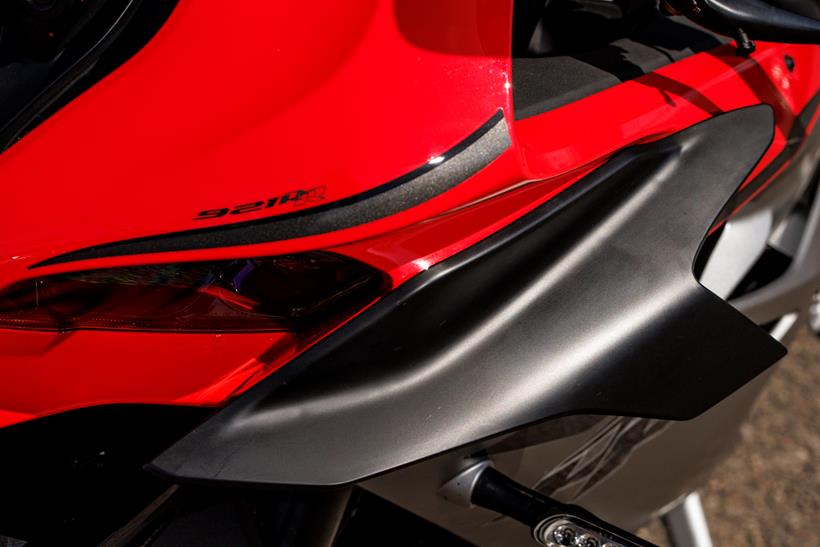
QJMotor’s front fairing design, LED headlights and daytime running lights bear more than a passing resemblance to the original Ducati Panigale’s. Wings should give downforce at track speeds but are more of a styling exercise on the road.
Brakes
Brembo’s monobloc four-piston Stylema callipers were used on the 2018 Ducati Panigale V4 and were so exclusive Ducati were the only ones allowed to use them that year. Who would’ve thought they’d end up fitted to a nine-grand sports bike?
Bodywork
Penned by Adrian Morton and built in China, the plastic bodywork and panels are excellent quality and fit together perfectly with neat panel gaps and fixings. Paint finishes are deep, and attention to detail has been well thought through.
Exhaust
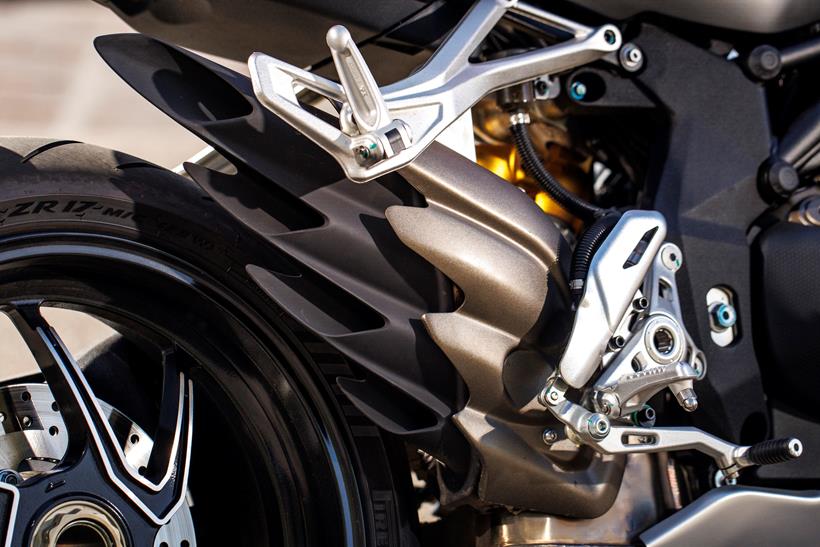
Slash-cut end pipes are the carbon copy of those found on MV Agusta’s 2012 F3 675, but of course, in this case there are four of them – not three. Its raw, crunchy, mechanical soundtrack is textbook MV and suitably loud at full throttle.
Who are QJMotor?
Qianjiang Motor produce a wide range of over 200 powered two-wheelers for their domestic market, from commuters, scooters, adventure bikes and nakeds to 600cc V4-engined cruisers and electric superbikes with clutches and gears.
They’re also the company behind Benelli’s recent revival and are now regular top 10 finishers in World Supersport with the four-cylinder SRK 800 RR and are expanding in the UK with 22 QJMotor models available in 38 dealers.
They partnered with MV Agusta a few years ago with a plan to produce their machines, like the Brutale, for the Chinese market, which is why the SRK 921 RR is so similar. That tie-up never took off after KTM partnered with MV Agusta, but that fell flat too after the Austrian firm’s 2026 financial woes.
MCN Verdict
‘Super-stable backroad scratcher’
The QJMotor SRK 921 RR impressed. Only the name on the tank gives away its birthplace because everything from the way it’s styled to the way it goes is on par with the MV Agusta it’s based on.
Sure, it has some quirks: it could do with a remap to polish the fuelling, and it’s ridiculously heavy for a sports bike and has slow steering, but they’re classic old-generation MV traits. It’s still a hugely capable back-road scratcher that’s super-stable on UK backroads, loaded with midrange torque and has just the right amount of power to take your breath away.
Best of all is the price. Not only do you get a well-finished, high-performance, raw-sounding machine for your £8999, but it also comes with top-notch chassis parts, lots of electronic goodies and designer-label styling. The longer we spent with the SRK 921 RR, the less we judged it as a ‘Chinese motorcycle’, and the more it became just a ‘motorcycle’ and a very good one at that… until the engine fault dented our confidence a little.
Deja una respuesta