
A serious bike, with more focus!
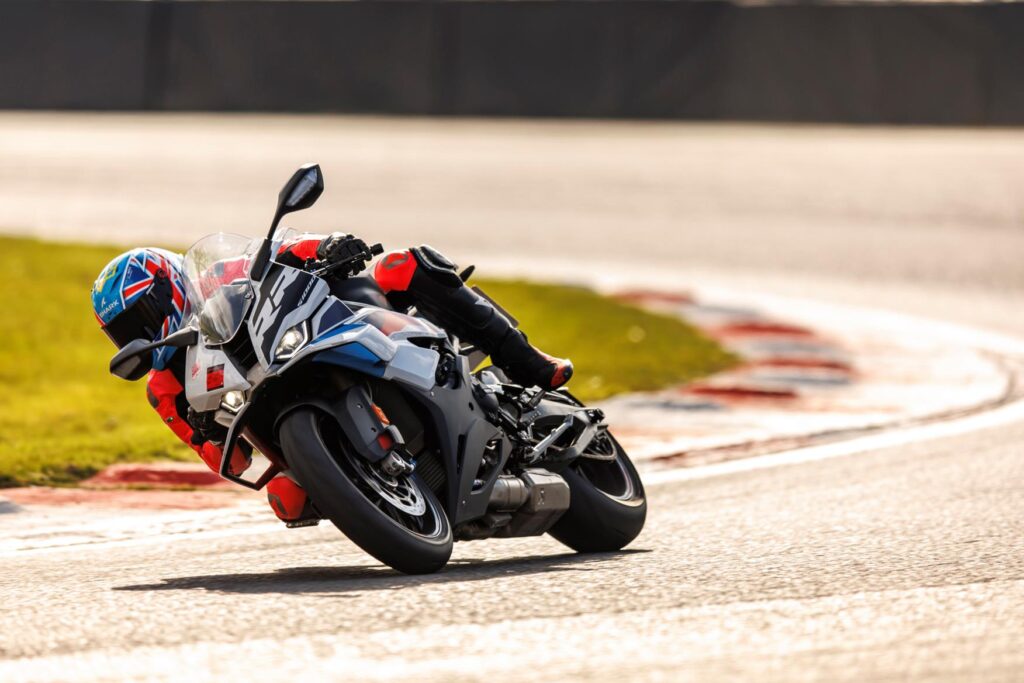
Although it’s taken until 2024 to see the short-circuit success that BMW have been longing for, the S1000RR has been a massive hit for road riders since its release, all the way back in 2009. In fact, the S1000RR doesn’t just regularly outsell the rest of its superbike competition, but it smashes sales out of the ballpark, sometimes selling well over double its best-selling litre rivals in the U.K.
For 2025, the S1000RR is about evolution rather than revolution, with a few tweaks to the motor (that is now Euro5+ compliant), a revised aero package, some additional riding modes and a quick action throttle, adopted from the homologation special M1000RR.
Although the S1000RR has seen a raft of updates over the years, the 2025 model still has that same essence of the original model, with a poised and predictable inline-four motor, a great level of stability and a roomy cockpit that does allow for a little bit of comfort for longer journeys.

Yet with every iteration, it has become a more serious proposition and the 2025 model takes that a step further, with a more aggressive appearance and the shaper, more direct feeling from the throttle.
On track, the RR feels precise, but closer to an extreme superbike with headlights. Compared to previous generations, the 2025 model is more focussed and requires a little more rider input to muscle it around, but when done so, the rewards are greater. It’s the S1000RR we all love, with some additional spice thrown in for good measure.

Ride quality & brakes
Next up: Engine
Gone are the days of litre superbikes being cramped and small, as the S1000RR is a surprisingly roomy, and a rather large beast to straddle. When equipped with the optional ‘M’ Footrests (£1,012) the rearsets offer a huge amount of adjustability in their positioning, and the space between the seat and the ‘bars is vast, suiting a larger rider.

The riding triangle isn’t too aggressive for a sportsbike either, and even at motorway speeds, the screen offers a reasonable amount of wind protection. The aftermarket heated grips (£260) are incredibly effective on a cooler day too, offering a good amount of heat, even with thicker gloves.
In terms of its cornering and braking abilities, the S1000RR is sharper than ever – however, that means that it’s incredibly firm on the road, even in the softer, ‘Road’ mode. Although it turns with impressive precision, the RR’s ride quality is on the harsher side of the spectrum, while the brakes are impressively sharp too, with little intervention from the ABS.

However, on track it comes into its own. The S1000RR is one of, if not the sharpest litre superbikes on sale today, with a chassis and suspension set-up that will swallow anything thrown its way. It feels like a well sorted track machine as standard, with incredible poise and precision. The feedback through the suspension and chassis is truly incredible too, working better the harder it is pushed.
Engine
Next up: Reliability
BMW’s flagship sportsbike has always been known for its smooth, linear engine, and even in its latest, Euro5+ guise, it retains that character – for the most part. It’s happy to sit a gear or two too high and will even sit at motorway speeds without feeling too eager, which is helped by the handy additional of cruise control (£370).
But because it’s so smooth from just a few thousand RPM, you always have to be mindful of that mammoth power figure as it will achieve licence-losing speeds without ever even breaking a sweat. When it’s wound up, the RR is deceptively fast and carves through gears with an almost impossible level of silkiness at the top end. It’s seriously composed and is an incredible asset that will climb into the triple mph digits with no drama whatsoever.

However, for ’25 the S1000RR comes equipped with the M’s quick action throttle, reducing the range from 72° to 58°, and it is quite eager at very single-digit speeds, even in the softer engine settings.
On the road it’s very enthusiastic (even in the softer modes), but it’s on track where the S1000RR feels most at home. That 999cc motor eats up straights without a thought and makes an incredible amount of mechanical grip in the process. The combination of those big wings and impressive electronics also do a sterling job of getting the RR moving forward, while still remaining stable on the power.
Reliability & build quality
Next up: Value
Although very early S1000RRs suffered a few minor issues, BMW seem to have addressed those problems, and the dealer service tends to be positive.
For the previous generations of S1000RR, owners' reviews show a mixed bag when it comes to reliability. Some are happy, while others state they've had serious problems, although with the 2025 model relatively unchanged, we’d like to think that any problems have now been ironed out.
We are also running an S1000RR on our long-term test fleet for 2025, so keep an eye out for our updates from our Deputy Editor Carl Stevens ownership experience.

Value vs rivals
Next up: Equipment
Although the S1000RR Sport starts at ‘just’ £19,310, that is for the very basic specification, and it doesn’t take long for the cost to add up for additional goodies.

For context, Ducati’s Panigale V4 S cost £29,995, Aprilia’s RSV4 Factory 1100 will set you back £23,859 and Honda’s CBR1000RR-R Fireblade SP is £23,699, while Bimota’s new KB998 Rimini costs just over £36,000. On the flipside, Kawasaki’s ZX-10R is £17,499.
Our test bike is equipped with the £1260 Dynamic package that gives the RR heated grips, cruise control and Dynamic Damping Control, the £1625 M Titan exhaust system, the £435 ‘M’ billet package levers and the £5010 ‘M’ package, which includes a host of extras such as carbon wheels, along with the blue calipers and the white colour scheme.
Although this bumps the price up, it is possible for you to spec your RR to exactly how you want it and leave off what you don’t need.

Equipment
As you might imagine, the 2025 S1000RR comes with all the bells and whistles imaginable on a litre superbike, alongside a few additional creature comforts too. A six-axis IMU powers a raft of modes and switchable rider aids that cover everything from cornering ABS and traction control to launch control and Brake Slide Assist, and even a pit-lane limiter. The electronics are impressively effective.

This is all powered via a 6.5” TFT dash that is relatively easy to use and has Bluetooth connectivity that will hook up to the free BMW app in order to record your ride and use maps. Heated grips and cruise control are an extra, but they’re both effective systems that add another dimension to the RR’s road-going abilities.

Deja una respuesta