
2025-on Benda LFC 700 review: Modern cruiser reimagined
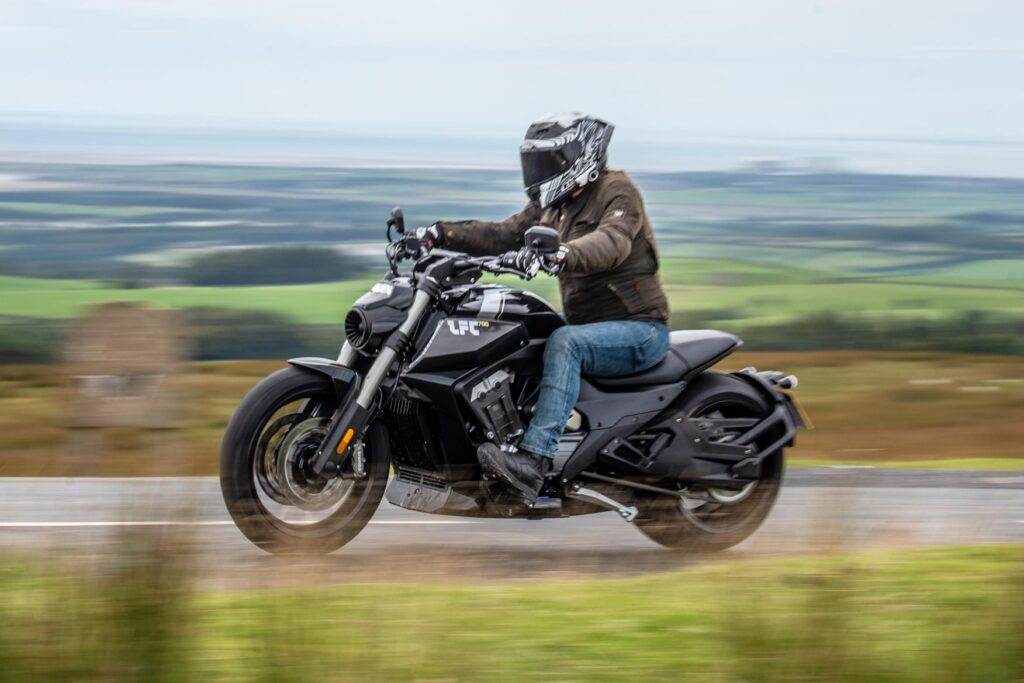
Motorcycling has always been about attitude. Whether you’re a cost-conscious commuter threading the needle of frugality, a track addict dreaming of factory-prepped performance or a go-anywhere adventurer with all the gadgets, there’s a deep-rooted passion that drives the way we look at bikes and how we want to ride them.
And that’s no truer than in the cruiser market, where the very definition of the class is fun, freedom and a bit of flash. It’s about feeling that you’re doing what you want, in your own way, and to hell with the rest of them. Which is exactly where the Benda LFC 700 comes in.
Most mid-sized, laid-back street sleds can be a bit uninspiring, perhaps a tad too sensible, to really capture the imagination, but that most definitely isn’t the case here. The boffins at Benda appear to have ignored almost all traditional cruiser conventions, instead opting something that’s so off the wall it resembles an AI answer to the command ‘create a custom bike’.
From the orange-squeezer air intake and crackle-coated cast aluminium frame, to the in-line four engine and unfeasibly large rear tyre, it’s a bafflingly bizarre collection of parts, all of which somehow come together to create a manga-type monster brooding with urban menace.

But let’s not get ahead of ourselves, because it’s easy to get carried away when faced with the LFC 700’s striking appearance. Despite the dystopian drag strip looks, this isn’t some red-blooded, fire-breathing muscle bike waiting to tear your arms off; it’s a well-mannered, nicely turned-out middleweight, that just happens to do things a little a bit differently.
The 676cc in-line four, a unique arrangement for a cruiser, only produces 85bhp, and with 44ft-lb it’s not going to win many traffic light grand prix. It’s noisy and raw, but in a way that’ll make you smile and keep pushing, rather than back off the gas in embarrassment. And then there’s that huge rear tyre that makes a statement all its own.

So while the LFC 700 may not have the go, it has an abundance of show and a presence that will turn heads wherever you roll up. Unconventional to look at, it’s well put together with plenty of attention to detail, although some elements, such as the rear mudguard, do feel a little like an afterthought.
The Benda is not a sportsbike by any stretch, but the experience is relative, and it delivers the goods with a feel-good factor that only comes with certain oddball machines – as a fair weather cruiser it’s absolutely bang on. For all its bonkers image, it’s easy to live with, reassuringly manageable and will no doubt make perfect sense to somebody. £9199 on the road is a fair wedge for a flight of fancy, but if you want something that titillates the senses to deliver an experience you can’t get elsewhere, then you may just be that person.
Ride quality & brakes
Next up: Engine
And so to that gargantuan rear tyre, and what it means for the handling. At 310/35-18, it’s the biggest OE fitment on any production motorcycle, which fits right in with the LFC 700’s larger-than-life personality.
By comparison, both the Ducati Diavel and Triumph Rocket 3 run 240-section tyres, and with a wheelbase of 1720mm the big Benda outstretches everything this side of the king-sized BMW R18. Not that they’re rivals, it just puts things into perspective.

The overall tread width makes poorly surfaced roads a challenge, as it tends to perch on the edge of potholes or tramline into troughs, and takes some effort to counteract heavy cambers and keep away from the kerb. Bumpy country roads aren’t the LFC700’s natural habitat though, and on smoother stuff it’s less of a handful than you might imagine, and actually pretty good fun.
Slow, tight turns, such as roundabouts, initially instil a touch of dread, but by leaning into the bike with your lower body while pushing on the inside bar for a touch of countersteer, it pivots neatly around the massive contact patch to track confidently through the desired arc.

It’s satisfying to feel you’re getting the better of such a big beast, and enjoyable too. As speed increases, it becomes easier to roll around bends, and with 160mm of ground clearance there’s a fair amount of lean to play with.
The 41mm KYB forks have compression adjustment and are perfectly adequate for the job, but the rear shock deserves special mention for keeping the chassis tamed while providing top-notch comfort. On the bumpier roads around the Forest of Bowland, where our test took place, it was suitably sprung to prevent bottoming out, with adjustable damping set up for a plush, posterior-pleasing ride.

Although it may not look so to a casual observer, the riding position is rather comfortable, and more to the point, it suits the bike. There’s quite a reach to the bars, which results in a fairly aggressive stance, and with feet forward you’re dealt another illusion of being on something particularly wild. Seat height is 695mm, keeping flat-footed security in reach of most people, but there’s no denying that there’s a lot of bike to manage when paddling about for a parking space.
Radial Brembo brakes with twin channel ABS ensure the stopping power to reel in the 287kg bulk as required, the rear being particularly effective thanks to all that rubber on the deck.

Engine
Next up: Reliability
The transversely mounted 676cc in-line four is the first of its kind in a production feet-forward cruiser, but although it won’t give you any bragging rights where outright power is concerned, it does bring a hilariously visceral touch to the proceedings. To reach its modest peak of 84bhp, the motor needs to spin up to 10,300 rpm, producing a raucous, banshee-like wail from the airbox in the process.

It sounds outrageous and gives the sensation of piloting an absolute screaming bruiser of a thing, yet when you look down at the speedo you’re presented with the kind of double digits that you don’t have to worry about losing your licence for.
Max torque kicks in at a heady 8000 rpm, but while its 44ftlb is a far cry from earth shattering, power delivery through the rev range is at least smooth and linear. The bars and footpegs begin to buzz at around 6000 rpm, which is motorway speeds in 6th gear, but it’s not a bike you’d really want to spend too much time riding three-lane dual carriageways on.

From a practical viewpoint, the motor makes little sense, but then neither does the rest of the bike. There’s no grunty bottom end or outright rush of power, instead it’s a docile, user friendly unit that never gets overwhelming and is open to a good thrashing should the mood takes you. There are no maps or modes to switch between, however fuel delivery is spot on, and as a result, throttle response is measured and unintimidating.
Gear changes are slick and fuss free, and although clutchless up-shifts take little more than a committed foot twitch on the forward controls, action at the clutch lever is reassuringly easy. Final drive is old school chain and sprockets.
Reliability & build quality
Next up: Value
Build quality appears to be very good for the most part, and Benda have a done a great job in routing cables and hiding wiring looms. The cast aluminium frame and swingarm is finished in an unusual textured powder coating that looks like plastic trim.

It no doubt adds a layer of protection, and like the LFC 700 as a whole, has a ‘wipe clean’ air about it.
There are neat touches like the rear axle/chain adjuster covers, but the numberplate holder and infill where a conventional headlight would be look a bit like last minute additions. The bike comes with a two-year unlimited-mileage warranty.

Value vs rivals
Next up: Equipment
The LFC 700 is a brand new bike to the market, so there's no history as yet. Servicing is every 4000 miles/annually.
When considering the Benda's engine size, power and layout there are currently no direct rivals. Priced at £9199 on the road, it's cheaper than many of the already established cruisers.

Equipment
Apart from the ABS, there are no electronic rider aids, but to be fair, the LFC 700 can live without them. Straight runs long enough to feel the need for cruise control are best avoided, and if you’re regularly giving it enough beans to break traction, then this probably isn’t the bike for you.
Equipment wise there not very much to shout about at all. The 5in TFT dash is above the generic average, displaying the basic info clearly and concisely.

A USB-C socket provides a power source for electronic devices, and LED lighting all-round lets you see and be seen.
Backlit switchgear is handy for night riding and the bar end mirrors can be swivelled to either an over or under position.

Deja una respuesta