
2026-on Triumph Trident 800 review: Friendly with extra fizz
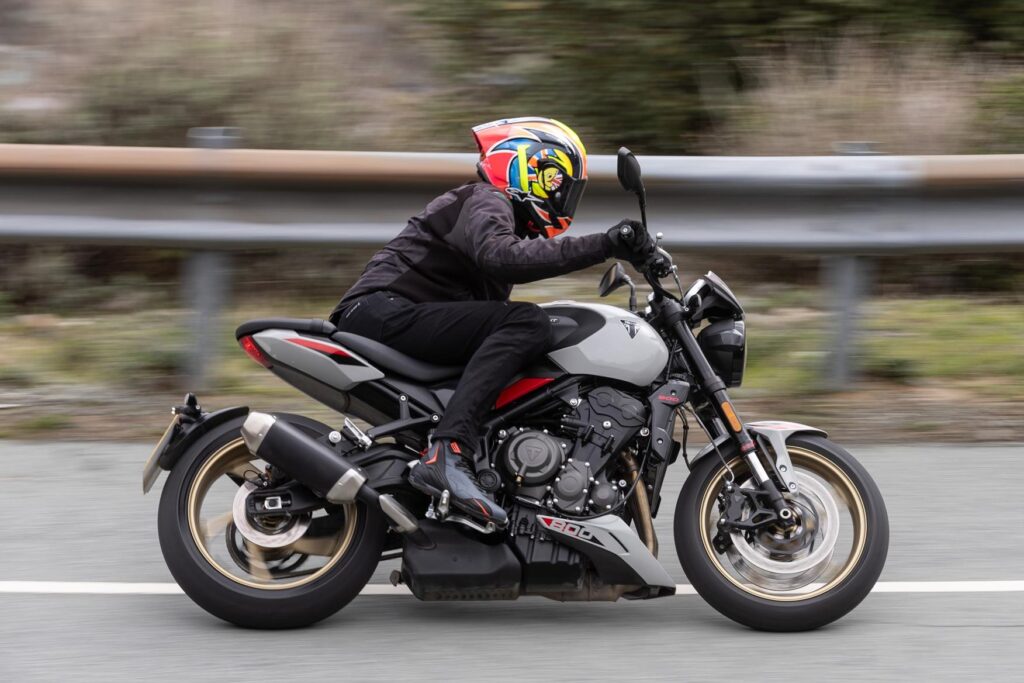
Although the Trident 800 shares its tubular steel perimeter frame with the Trident 660, its inner rails are scooped out internally to accommodate its bigger throttle bodies and airbox. Upside-down forks are adjustable for rebound and compression damping and the rear shock for preload and rebound damping.
Braking power is courtesy of Triumph-branded J.Juan four-piston calipers biting twin 310mm discs. Wheels are shod with Michelin Road 6 sports touring tyres (120/70 x 17 front, 180/55 x 17 rear).
Compared to the Street Triple R, the Trident 800’s ergonomics are far more relaxed. Bars are 33mm taller, 34mm further towards the rider, raked back 1.6° and 8.5mm wider each side. The seat height is 16mm less and the pegs 36.5mm lower, which adds up to 20.5mm more legroom. The pegs are also placed 18.5mm further forward. The Street Triple 765 RS’s riding position is even racier…
The Trident 800 is friendly on your wrists and knees, and for a six-foot rider like me, I finish our day’s ride as fresh as a daisy. Even at motorway speeds, the windblast is minimal for a naked, with none of the brain-drilling buffeting you get on a tall-rounder or adventure bike.

The Trident 800’s chassis geometry is deliberately less sporty than a Street Triple’s, and it comes on sports-touring rubber instead of something racier. It isn’t meant to be a natural-born circuit weapon (although it would still be fun on a track day), but that doesn’t mean it doesn’t handle. Far from it.
You can tell off the bat the steering isn’t racer-sharp, but the Triumph is still agile, rolls beautifully through fast and slow corners and can pick its way serenely through town and around roundabouts. Despite its comfy peg position, there are no ground clearance issues, either.
Most impressive is the feel and confidence the Triumph gives to the rider. Our ride is mostly made up of second to fourth gear mountain bends on all kinds of tarmac, from billiard-smooth to ruts and potholes.

The combination of Michelin’s finest Road 6 tyres, which are ‘good to go’ immediately, and Triumph’s handling knowhow is formidable. You always know exactly what’s going on beneath you, via your hands, feet, and bum, as you roll through a corner and power out. It’s so easy to ride at a pace, even in the wet, it feels like cheating.
It might not have the latest Öhlins hardware, but ride quality strikes a decent balance between control and comfort for a bike at this price. Furthermore, it’s generally plush, but the rear can be harsh over big bumps and slightly underdamped when you’re pushing on.
That said, the set-up is perfect for the mixed conditions we experience during our test and there’s no urge to twiddle with the suspension adjusters. But for sporty riding on bone dry roads, the shock’s rebound damping may need to be slowed down a touch.

Front and rear brakes are nicely metered with feel and power, without being aggressive, and even on slippery roads there’s so much mechanical tyre grip the cornering ABS is barely troubled, even when pushing hard.
Deja una respuesta