
2026-on KTM 1390 Super Adventure S Evo review: Tech evolved
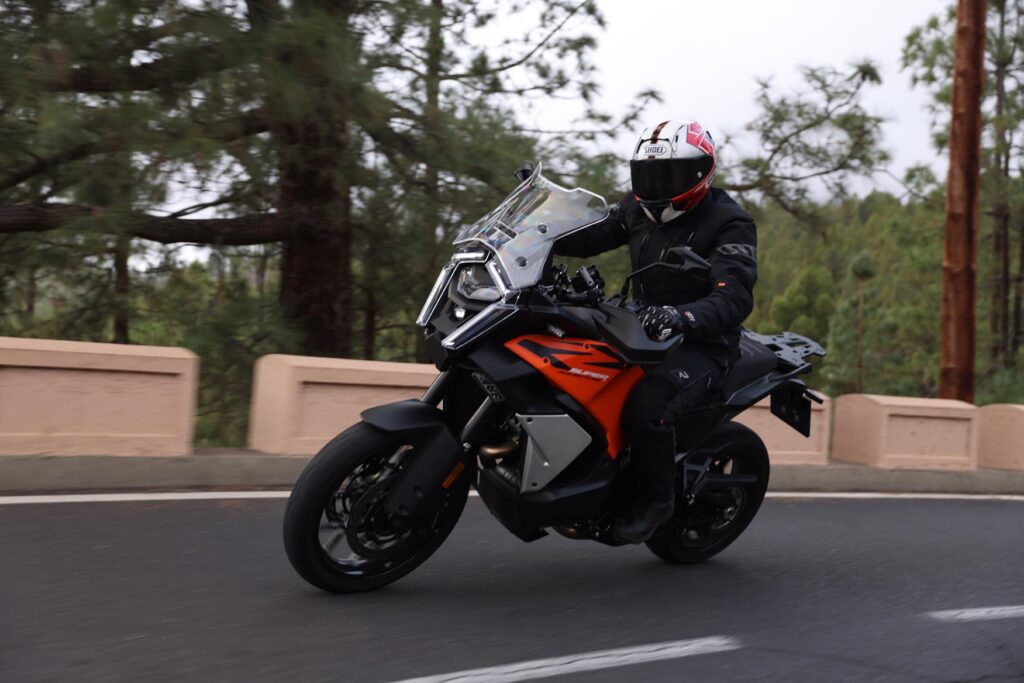
The 1350cc 75° v-twin LC8 motor can trace its ancestry back 20 years or so to the original 950 Adventure, which proved that adventure bikes could be sporty performers too, and that’s a fundamental part of KTM’s ethos. And this version of it is the most advanced yet. A bigger bore with shallower pistons provides an extra 49cc over the 1290, and along with wider, shorter throttle bodies, that has pushed peak power up to 173bhp and increased torque to 107lb.ft.
New to the 1390 is ‘Camshift’ technology, a form of variable valve timing which KTM say is designed to increase performance and improve efficiency. The inlet camshaft has an outer sleeve with two sets of valve actuating lobes, one with a more performance orientated profile than the other. A control unit in the cylinder head automatically shifts from one to the other at 6500rpm, which in practice means a smoother, less spiky, throttle response at lower revs and full power when you want to crack on.
Even at idle, you can feel that trademark KTM raw, hard edge vibrating through the bike - and that brings us on to gear selection. The Automatic Manual Transmission (AMT) allows you to drop the S Evo into gear either by a conventional foot lever or via up/down paddles on the lefthand ‘bar. At standstill, it won’t work unless you’ve got a brake applied, and the shift pattern includes a ‘Park’ mode, making the sequence P-N-1-2-3-4-5-6.
Switching between automatic or manual shift is easiest via a push button on the right ‘bar.

There’s no clutch lever to allow slip on pull away, which initially feels a daunting prospect with so much power on tap. Instead, it has a centrifugal clutch that requires an increase in engine speed to engage its drive plates and provide power to the gearbox and subsequently the final drive – to twist and go, the magic number is 1900rpm. The engine’s softer characteristics at lower revs really helps with this, but even so it requires a leap of faith the first few times you try it.
As standard, the S Evo has four ride modes, Rain, Street, Sport and Off-road, each with a specific setting for throttle response, engine braking, traction control, suspension, and the AMT’s auto shifter. Each one of those settings has its own adjustable parameters, with even more options available when you start adding additional software packs.
If that’s starting to sound complicated, then we totally understand, but the bottom line is that all you really need do is pick a ride mode, choose how you want to shift gears, and let the 1390’s clever array of sensors, monitors and control units to do the rest.

With ‘Street’ and ‘Auto’ selected we start to get a feel for the S Evo at slower speeds, tackling some town work, roundabouts and so on. Fuelling is smooth and accurate, delivering drive in a such a controlled manner that it doesn’t take long to get over the fact that there isn’t a clutch lever, and managing the big KTM on throttle alone isn’t an issue.
Gear shifts occur with quite a clunk though, and its quickly in a higher gear than I would select myself, banging fairly heavily back down as we roll to a stop at a junction. Switching to manual lets me hang onto each gear a bit longer, and with higher revs it shifts much smoother.
As the route gets more rural, we try Auto again, and find that the system responds to a brisker pace and more enthusiastic use of the throttle by allowing more revs before shifting up. It’s impressive how quickly it adapts, and although not perfect is at least in the ballpark of where I would change gear. Downshifts are actually more on point, because even though the 1390 can’t predict the severity of a bend, the level of deceleration, throttle position and lean angle does give it an indication, and besides, it’s easy to drop an extra gear with a manual input.

But while manual controls can override the system, by its very nature Auto is less involving, and more suited to the kind of roads where speed is more consistent – think faster A roads, dual carriageways and motorways. For making progress through the twisties, Manual is where it’s at.
We’ve mentioned the traditional foot lever and paddle buttons, but there’s another way to shift gear with the AMT and that’s via the throttle itself. Crack it open and there’s a kick down function, and likewise snap it shut, and it’ll also drop down a gear.

With the ride mode now in Sport, the throttle is at its most direct and the suspension on its firmest preset. Stirring the LC8 with more gusto delivers oomph with a wallop, and we’re in no doubt as to its ferociously fast potential.
As a default, it’ll still auto shift at the redline (although you can set it to bounce off the limiter if that’s what you want), but clicking up gears on the paddle shift is just a twitch of the thumb, and for me at least, quicker than a foot change. The internal shift mechanism is a brushless electronic actuator that reacts almost instantaneously using quick shifter technology to snick between gears - and it’s virtually seamless.
Deja una respuesta